



Imagine waking up to a security alert that says your website is exposed, and the usual fix, that little "Update WordPress" button, won't save you.
That was the reality on October 21, 2026. The PHP project pushed emergency patches for two critical flaws, CVE-2026-109618 and CVE-2026-109619, nicknamed PHP2Shell. Both scored 9.2 out of 10. Both allowed remote code execution. And both lived not in WordPress, not in a theme, not in a plugin, but in the PHP engine underneath everything.
The Flaw Lives Below WordPress
As WP Umbrella explained for WordPress site owners, the flaw sits in PHP itself, so security plugins and firewalls running inside WordPress can't stop it. They only activate after PHP has already processed the request.
That distinction matters. WordPress runs on PHP, and PHP runs a huge chunk of the web. So when PHP itself breaks, millions of sites inherit the problem. Attackers didn't need a username or password. They could run malicious code before WordPress even started processing the request. That means total server control, stolen credentials, injected malware, backdoors, the whole nightmare.
Why Updating WordPress Does Nothing
Here's the twist that caught a lot of people off guard: updating WordPress does nothing. The flaw is in the server's PHP runtime, so you have to patch PHP itself. The fixed versions are:
- PHP 8.5.12
- PHP 8.4.27
- PHP 8.3.36
- PHP 8.2.35
What you do next depends on how your site is hosted:
- Managed hosting: ask your provider to confirm your site runs one of the patched versions.
- Your own server or containers: update PHP manually and restart the service.
- PHP 8.1 or older: you're out of official support. That's a migration emergency, not a maintenance task.
Convenience Has a Cost
So what's the lesson? Convenience has a cost. WordPress is built on a shared runtime and an ecosystem of plugins, and when something deep in that stack goes wrong, site owners are left waiting on hosts, plugin authors, and platform updates.
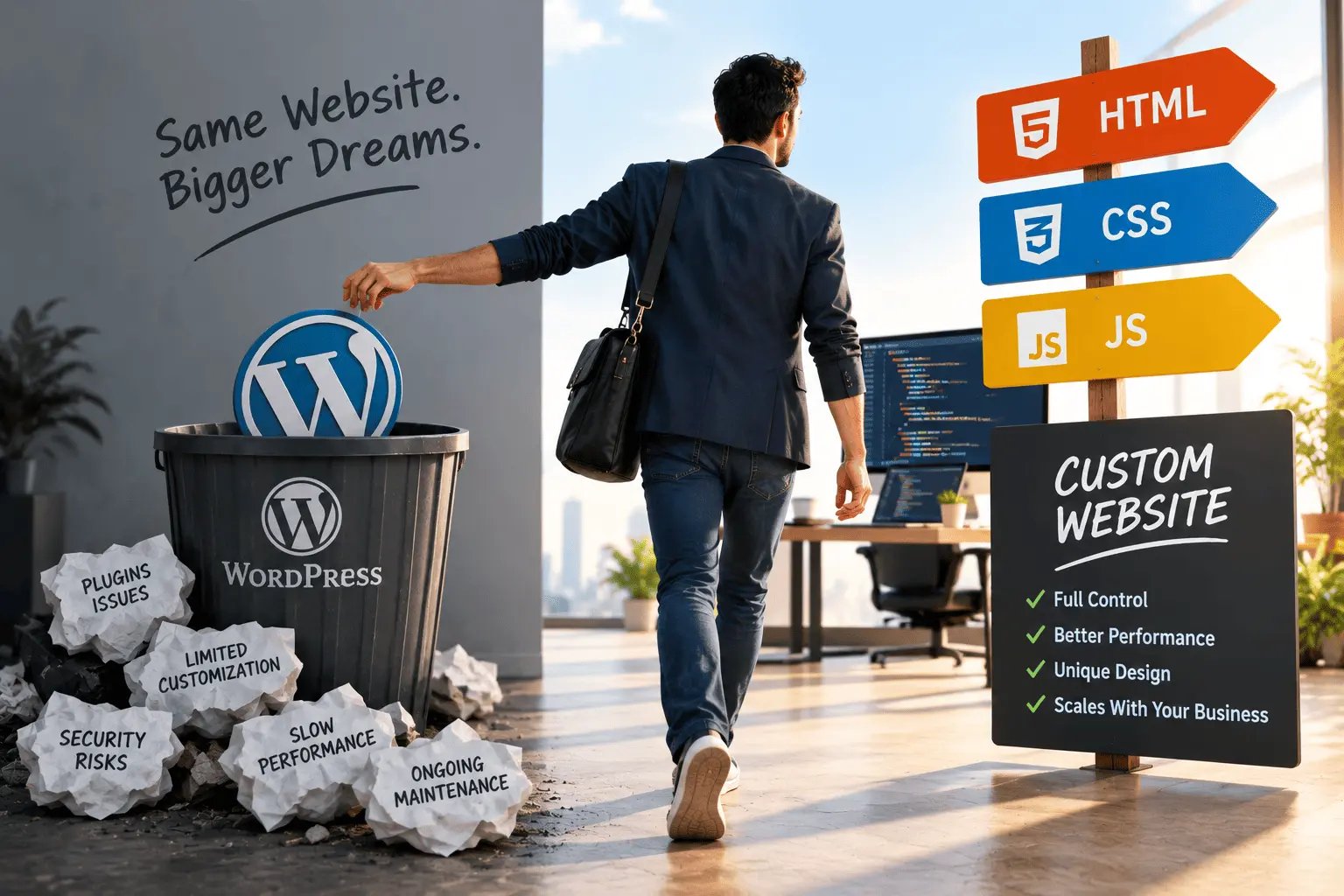
This is where a different approach makes sense. Rather than patching around a platform you don't control, Websitero builds custom-coded websites from scratch using clean HTML, CSS, and JavaScript. No PHP runtime on the server. No plugin maze. No "update the CMS and hope" reflex. Just lean code you own, built to perform from day one.
Who Controls Your Foundation?
This won't be the last security scare. The real lesson isn't about one emergency patch, it's about who controls the foundation your website is built on. When that foundation belongs to someone else, every alert leaves you waiting: on your host, on a plugin author, on a platform update.
With Websitero, you're not waiting. You own the code, the site, and the next decision.
Build a custom-coded website you fully own with Websitero.com.
